

By Celeste Lear | XR Experience Designer, Creative Technologist & Strategic Development, TigerVision
From concert stages and Hollywood virtual production studios to the engineering feat of the Sphere in Las Vegas, LED technology is evolving from a medium for video into a platform for immersive, spatially expansive environments. Curved, cylindrical, and spherical displays are opening new possibilities for storytelling, simulation, scientific visualization, and experiential design.
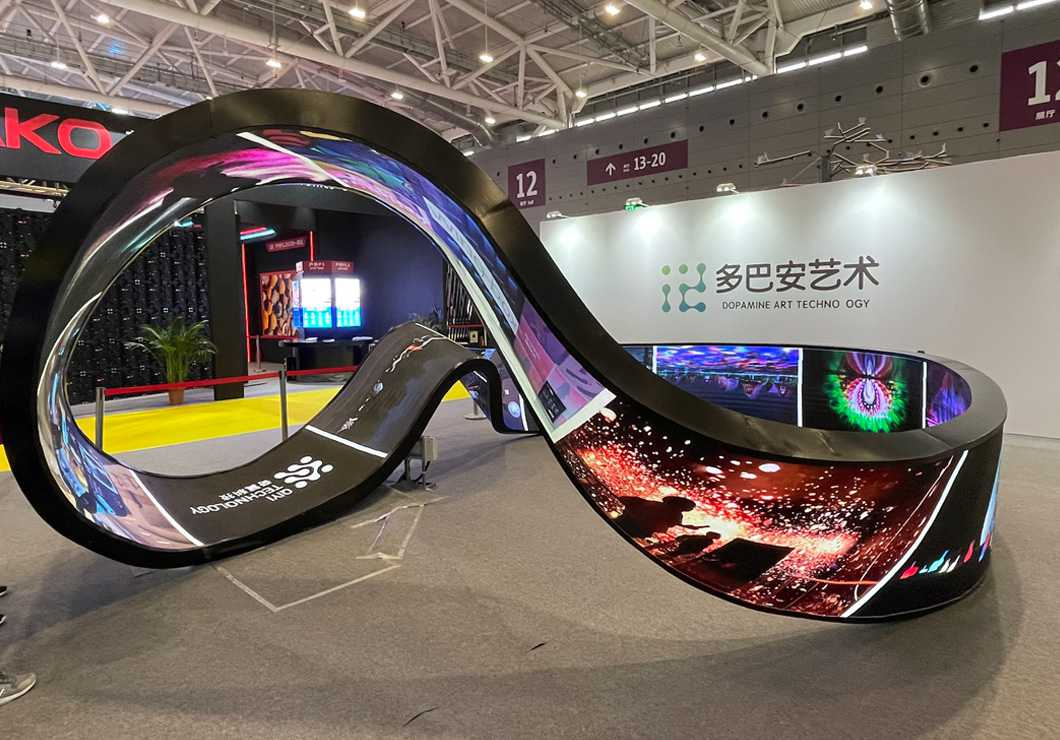
Dopamine Art Technology, a Chinese creative technology and immersive installation company, by DOIT VISION
Unlike projection, direct-view LED generates its own light, and advances in pixel pitch, modular panels, image processing, and curvature now create seamless environments that surround audiences. Training and simulation teams are turning to LED to reduce headset fatigue and replace projection, gaining brightness, contrast, and lower maintenance. For aerospace and defense, that means more realistic simulations, greater efficiency, and potentially lower long-term costs.
Beyond the Sphere's spectacle lies a bigger shift: instead of framing content in a rectangle, designers can build panoramic visual fields that mirror how we experience our surroundings.
I've worked with LED in Hollywood's virtual production industry, where Unreal Engine environments replace backdrops and some location shoots, camera tracking syncs virtual and physical perspectives, and LED walls cast interactive lighting and reflections on actors and sets. This can cut travel, costs, and emissions, though net impact depends on each production's energy use.

Industrial Light & Magic’s StageCraft LED Volume Systems have revolutionized filmmaking
Entertainment technology is now crossing into other industries. TigerVision builds patented curved and spherical "Surround Reality™" LED systems for aerospace, defense, aviation, and advanced simulation. CEO and patent holder Steve Welck began in immersive LED through his entertainment company, Immersive-FX, showing how creative innovation can become a tool for scientific, industrial, and government work.
At NASA's Johnson Space Center in Houston, TigerVision has deployed a 28-foot immersive LED system supporting lunar rover training for the Artemis program.
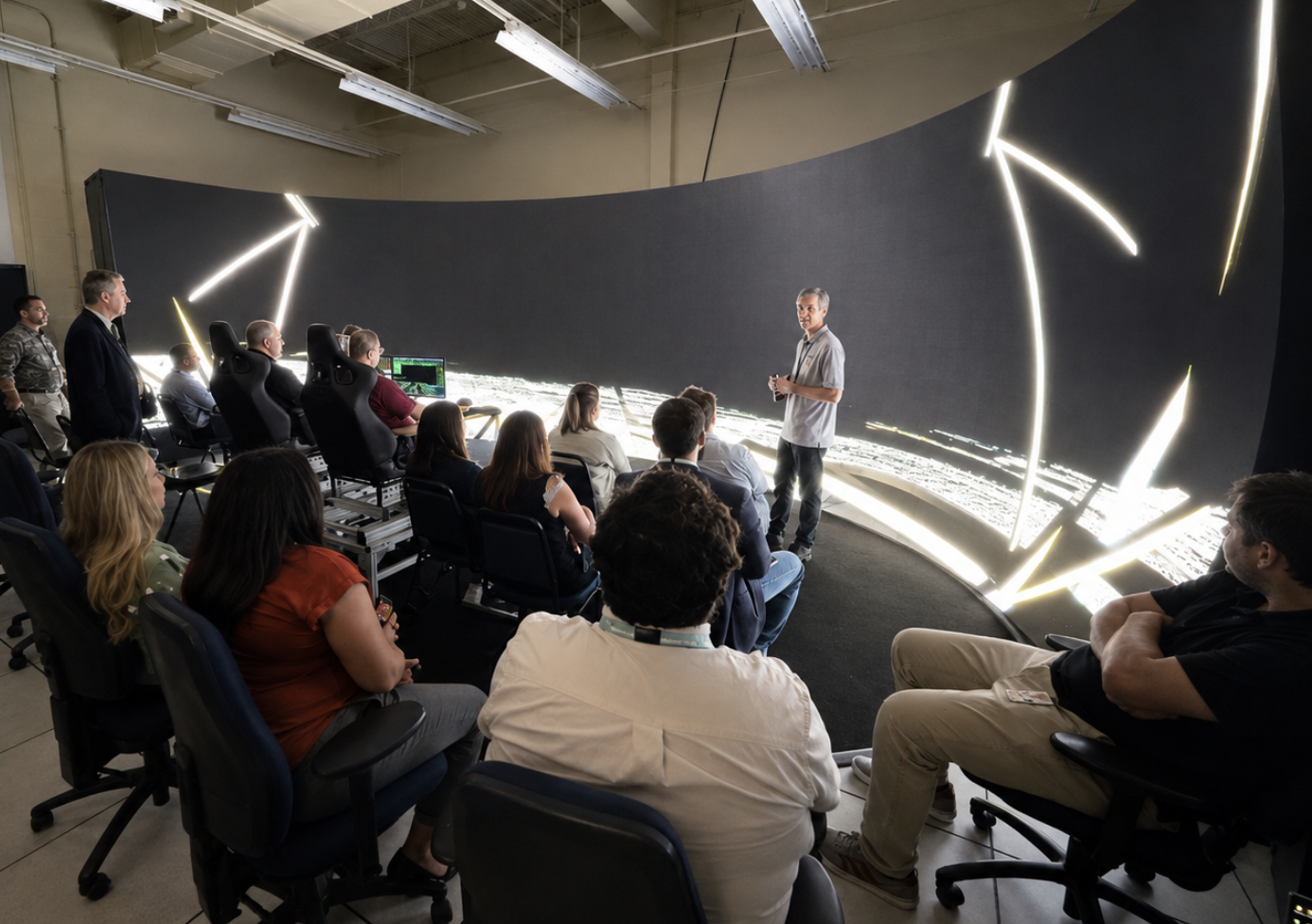
TigerVision R14 28’ Immersive Visualization system at NASA Johnson Space Center, currently used for Lunar Rover training and simulation in support of Artemis missions.
Wide-field displays support spatial orientation, situational awareness, and collaborative analysis, letting multiple participants study the same simulated environment, and can integrate with real-time simulation, tracking, and data visualization tools.
Challenges remain. Imagery on curved surfaces demands precise pixel density, viewing geometry, calibration, content mapping, latency, and synchronization, all critical for flight simulation and mission rehearsal, and this is driving innovation across hardware, graphics, and immersive software.
Having bridged entertainment and immersive technology, I find this convergence exciting: the tools filmmakers use to create imaginary worlds now help engineers visualize worlds beyond Earth. For the XR community, curved and spherical LED is a fast-evolving dimension of spatial computing that asks us to consider not just what we see on a screen, but how we design and interact with the environments around us.