

How Sankofa Inspired the XR Women History Park
by Elizabeth Desrosiers
When Karen Alexander invited me to build an outdoor space for XR Women, I was thrilled. I'd been looking for ways to volunteer my skills, and the opportunity brought together my love of 3D modeling, horticultural landscape design, and artistic collaboration.
In February, Karen and I met in XR Women's new FrameVR history space to explore its possibilities, including garden paths and outdoor galleries. The space was hosting its first event, a Community Build Day documenting Black women in XR for Black History Month. While we brainstormed, Tracie Yorke joined us with an intriguing suggestion: What if the park's layout was inspired by the West African Sankofa bird symbol?
The Sankofa symbol comes from the Adinkra traditiion of the Akan peoples of Ghana. Tracie explained how the bird, moving forward while looking back, symbolizes learning from the past and carrying that knowledge into the future. It felt perfect for a park celebrating the contributions and innovations of women in XR.
I approached the virtual park as I would a physical landscape, considering who would visit, where they might pause, and how one experience might lead to another. Within the bird's outline, I sketched galleries, gathering spaces, and connecting pathways.
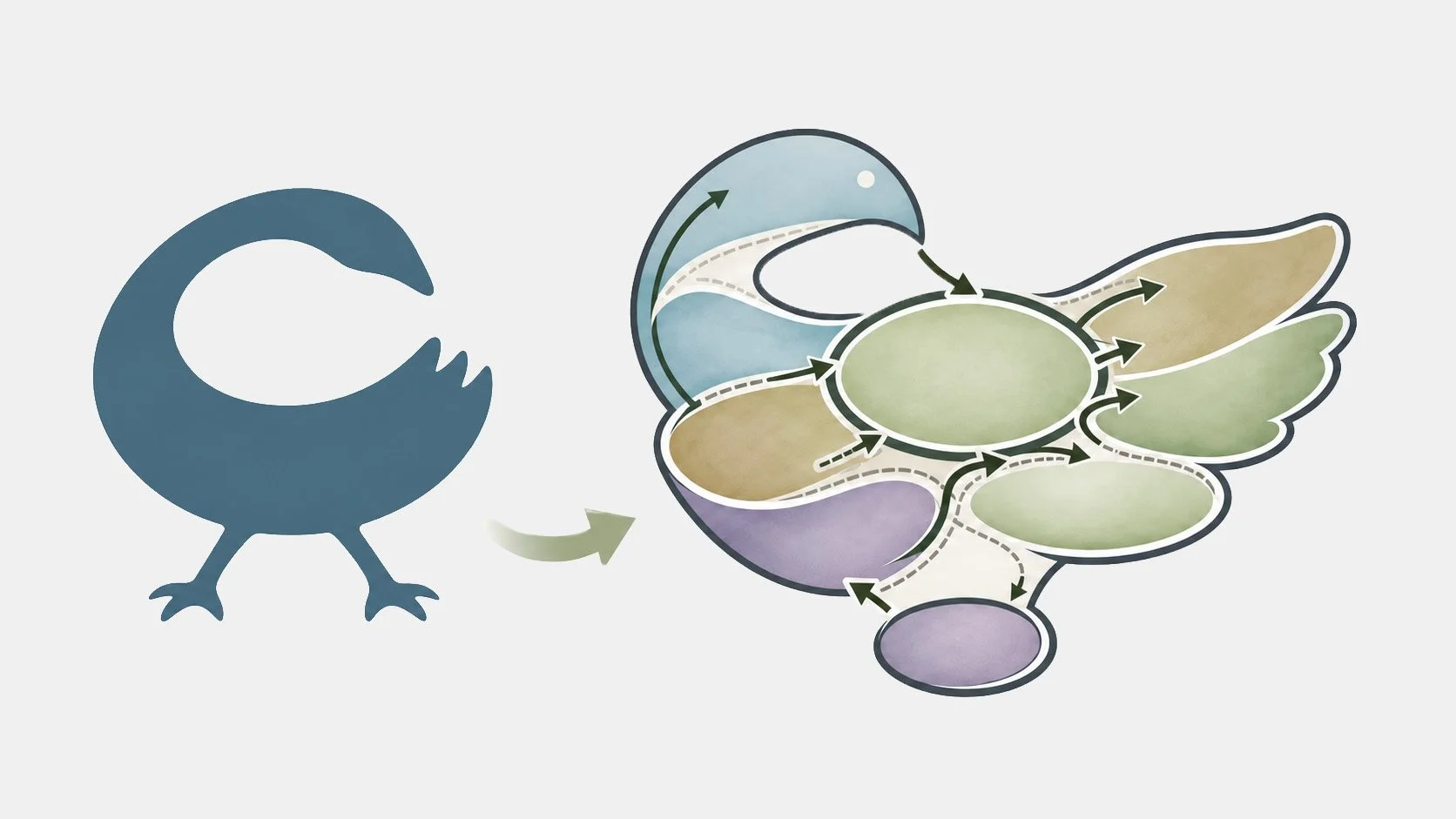
[Image: Sankofa inspiration and concept]
But then I wondered: instead of tracing the bird on the ground, what if the bird could rise out of the landscape?
Sculpted in SketchUp, the bird became a terraced hillside where visitors could climb to a lookout on its head, descend to a central gathering space, and explore a history pavilion and galleries along its feathers, discovering the women whose creativity and pioneering work continue to move XR forward.
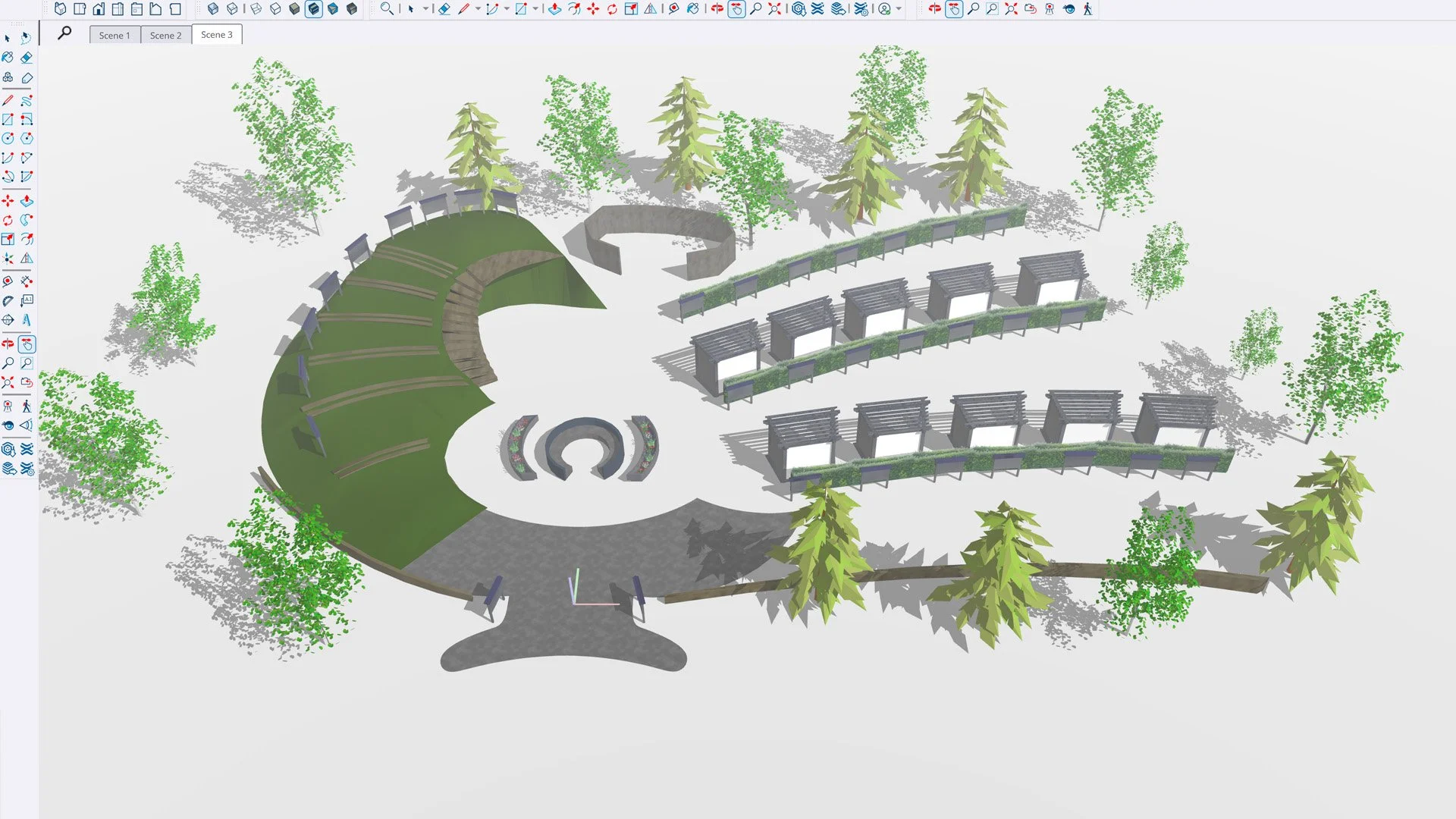
[Image: Sketchup rendering]
The next challenge was making the landscape work smoothly in FrameVR, a browser-based WebXR platform. GLB files exported from SketchUp can contain extra geometry, increasing file size and slowing performance. Blender was useful for model simplification, but then I discovered Claude AI could automate much of that work. I also explored the possibilities of AI-generated Gaussian splats, but limitations in editability and close-up detail brought me back to the flexibility of traditional 3D modeling.
Through these explorations, a six-step workflow emerged:
1. Model and refine the park in SketchUp.
2. Export the geometry as a GLB file.
3. Use Claude AI to reduce file size and remove unnecessary SketchUp artifacts.
4. Import the optimized GLB into FrameVR as the base environment.
5. Add an HDRI skybox to complete the outdoor settng.
6. Use FrameVR's Creation Menu to add and update park content, including interactive PDF presentations, posters, 3D sculptures, and portals to other XR Women locations.
Meanwhile, Karen was bringing the park's stories to life through extensive archival research, historical content development, and the creation of interactive exhibits in FrameVR. She thoughtfully organized the sequence of images and presentations, considering how different visitors might explore the park and connect with the women being celebrated.
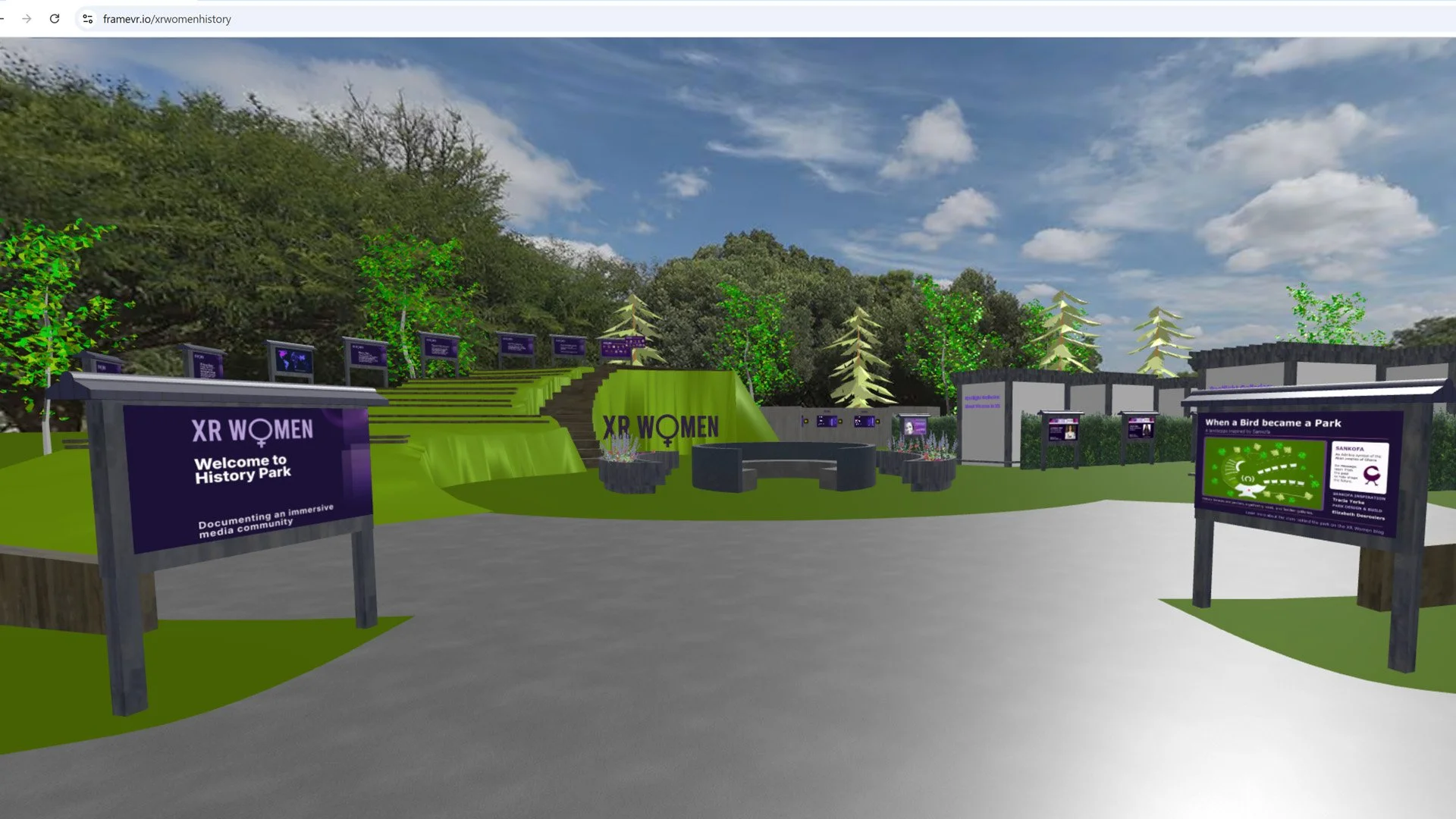
[Image: FrameVR implementation]
I'm grateful to Karen Alexander, an XR Women co-founder and Leadership Team member, for inviting me into this collaboration, and to Leadership Team member Tracie Yorke for the Sankofa inspiration. And I'm grateful for the XR Women community, whose stories will keep this landscape growing.