

Know Your 3D: What Every XR Creator Should Understand About Splats, Meshes, and Photogrammetry
by Christine Hobbi
As XR creators, we're increasingly making decisions about how to build immersive worlds — and those decisions start with one question: how should this 3D content be captured or built? Knowing the difference shapes your creative options, your timelines, and the quality of experience your users actually get.
The Three Methods
3D Objects (Polygon Meshes) are hand-built geometry — the backbone of interactive XR. Editable, animatable, and fully interactive. If your experience requires users to touch or manipulate something, you need a mesh.
Photogrammetry captures reality. Photograph a real object or space from many angles and software reconstructs it as a 3D mesh with photorealistic texture baked in. Powerful for bringing real equipment into XR — though shiny surfaces and fine details don't always capture cleanly.
Gaussian Splatting is the newest method. AI trains on photos to represent a scene as millions of tiny 3D "blobs," each carrying color, position, and opacity. Strikingly photorealistic, especially for environments — less suited for object-level interaction but extraordinary for presence and spatial orientation.
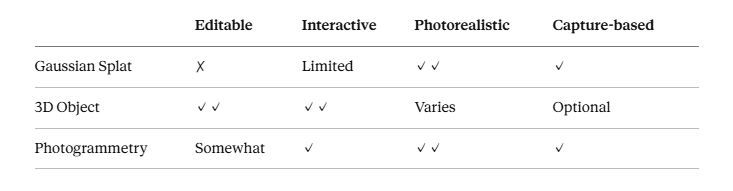
Comparison of Gaussian Splat, 3D Object and Photogrammetry
A Real-World Example
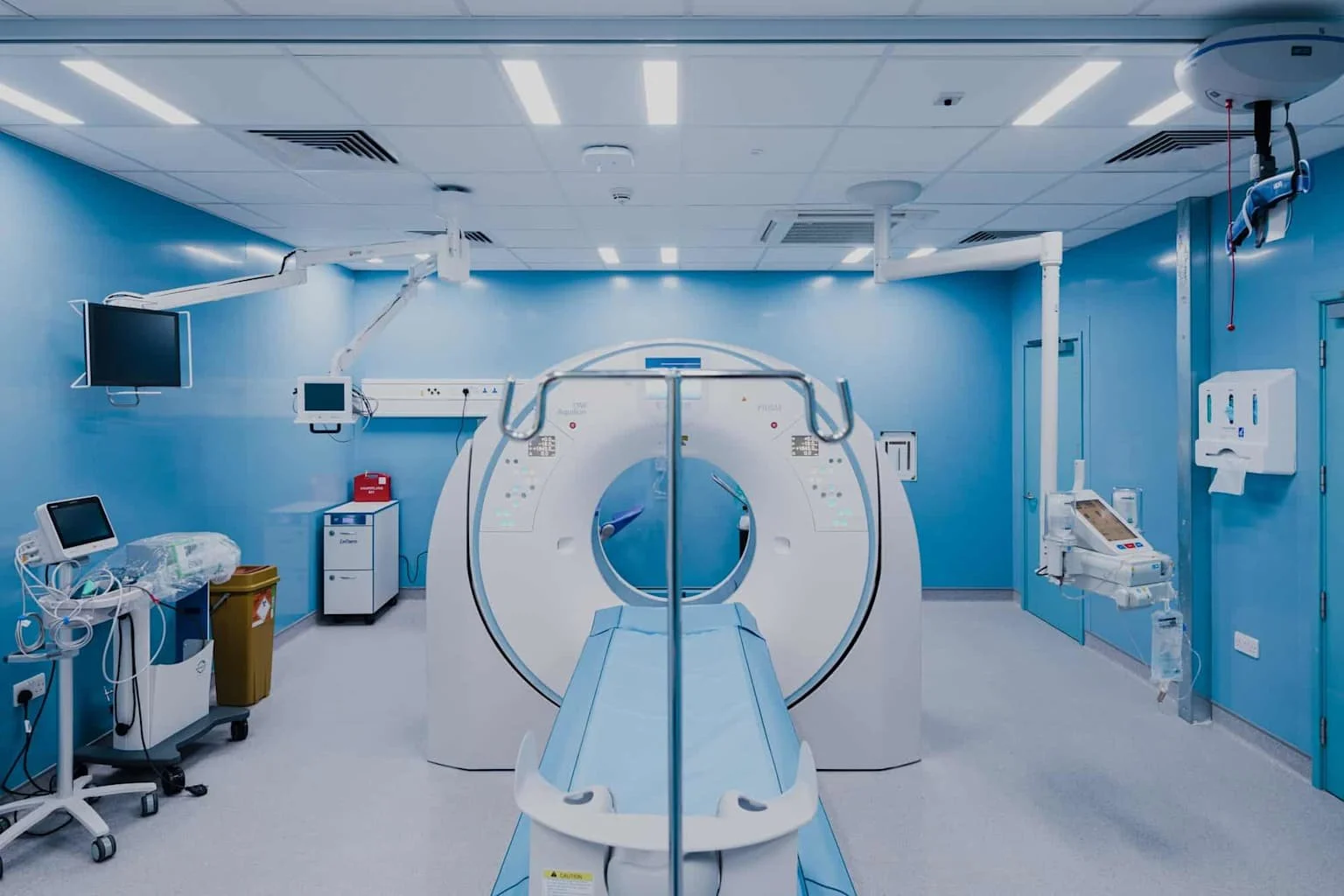
Designing XR training for medical imaging technologists? All three methods could work together in one course: a Gaussian Splat of the real clinical suite opens the experience so learners feel spatially oriented; photogrammetry of the actual machine lets them examine it with accurate surface detail; a 3D mesh of the control panels enables step-by-step procedural interaction. That layered approach is what separates a video with depth from genuine skill-building.
Here is a link to a Gaussian Splat the author created a couple years ago in Arrival Space “The Alien Abduction Phone Booth”. Alien Abduction Phone Booth by chill8523
It was a first attempt, and many improvements in the technology have been made. We have the tools right on our phones! If you want more information, put your questions or comments about these technologies in the XR Women Blog Conversations: https://xrwomen.slack.com/archives/C0AF89CUWG5
Why This Matters for XR Women
We are building the spatial web — and this space is moving fast. Just this week at WWDC 2026, Apple announced that iOS 27 will bring Gaussian Splatting to Apple Maps Flyover, rendering 300+ cities in photorealistic 3D using iPhone imagery and AI. And capture is already in your pocket: apps like Scaniverse, Polycam, and Luma AI let you create Gaussian Splats from your iPhone today.
Beyond Apple, Khronos ratified a cross-platform glTF standard for Gaussian Splatting, NVIDIA added ray-tracing support, and 4D Gaussian Splatting — dynamic, time-based volumetric capture — is opening doors that didn't exist two years ago.
The tools are in our hands. This is our moment to lead, not catch up.